

Home / The Charge / lifestyle
lifestyleCaffeine Pouches for Studying: Do They Actually Work?
Caffeine can lift alertness and perceived focus while you study, but it won't replace sleep, planning or comprehension. Here's how to use it sensibly.
Caffeine can genuinely help you feel more awake and mentally engaged during a study session, which is why so many students reach for it before exams. What it cannot do is guarantee better grades, replace sleep, or make difficult material easier to understand. The honest answer is that caffeine supports alertness and perceived focus, while the actual learning still depends on you.
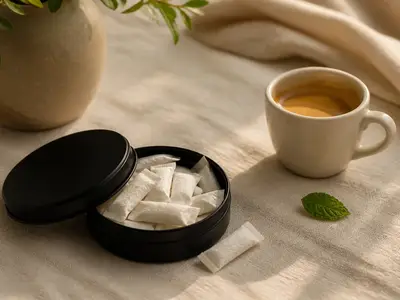
Caffeine pouches are one format for taking that caffeine. They are small, tobacco-free, nicotine-free pouches placed under the upper lip, releasing caffeine through the lining of the mouth rather than the stomach. If you are new to the format, start with what caffeine pouches are and how they work. This article looks at what the evidence really supports for studying, where the limits are, and how to use caffeine sensibly around your work.
What Caffeine Can and Cannot Do for Studying
Caffeine is one of the most studied stimulants in the world, and its core effects are well established. It blocks adenosine receptors in the brain, which delays the feeling of mental fatigue and can make a long session feel more manageable. Reviews of the research consistently link moderate caffeine to improvements in alertness, vigilance and reaction time (Einother & Giesbrecht, 2013; McLellan et al., 2016).
It is worth being precise about what this means. Caffeine reliably makes most people feel _more awake and attentive_, and it can improve performance on simple, attention-demanding tasks — especially when you are tired or under-slept. There is also some evidence that caffeine taken after learning may support memory consolidation (Borota et al., 2014), though this is a single line of research rather than settled fact.
What caffeine does not do is equally important:
- It does not replace sleep. No stimulant restores the memory consolidation that happens overnight, and chronic sleep loss undermines learning regardless of how alert you feel.
- It does not create understanding. Caffeine can help you sit down and pay attention, but it will not make you grasp a concept you have not worked through.
- It does not substitute for planning. Feeling switched-on is not the same as studying the right things in the right order.
- It does not scale linearly. More caffeine does not mean more focus — beyond a moderate dose it tends to add restlessness, not clarity.
In short, caffeine is a support for _alertness and perceived focus_, not a shortcut to academic performance. Treat it as one input alongside sleep, comprehension and a realistic study plan.
Why the Caffeine and L-Theanine Combination Matters
Caffeine on its own has a well-known trade-off: at higher doses it can make you feel tense, wired or scattered, which is the opposite of what you want when concentrating. This is where L-theanine, an amino acid found naturally in green tea, is often discussed.
When taken together, caffeine and L-theanine have been shown in several studies to improve accuracy on attention-switching tasks and to increase subjective alertness, while L-theanine appears to take some of the jittery edge off caffeine (Haskell et al., 2008; Giesbrecht et al., 2010). Many people describe the result as a calmer, steadier kind of focus. The effect is modest rather than dramatic, and individual responses vary, but the combination is one of the better-supported pairings in this space. If you want the mechanism in detail, see L-Theanine and Caffeine: The Science Behind the Combination.
Does the Pouch Format Help You Study?
The caffeine itself is what does the work; the pouch is simply a delivery method. Because caffeine is absorbed through the lining of the mouth, pouches tend to act somewhat faster than a drink you have to finish, and they let you take a fixed dose — a Revimit pouch contains 50 mg, roughly a strong espresso — without sugar or liquid. For a library, an exam hall or a quiet office, that can feel more convenient than brewing coffee or opening an energy drink. For a broader comparison of the two formats, see caffeine pouches vs coffee.
It is worth being honest here: there is limited direct research on caffeine pouches specifically as a study aid. The evidence for caffeine is strong; the evidence that the _pouch format_ improves studying over any other source of the same dose is mostly about practicality, not superior cognition. For how the format actually works, see The Science Behind Caffeine Pouches: How They Actually Work. A pouch is a portable, controlled way to take caffeine — not a categorically better study tool than a well-timed coffee. If you are comparing different products, our best caffeine pouches guide covers what to look for.
Timing: Caffeine Around Sleep and Memory
Timing is where caffeine can quietly work against your studying. Caffeine has a half-life of roughly four to six hours, which means a meaningful amount can still be in your system many hours after you take it. Used too late in the day, it can delay or fragment sleep — and sleep is when much of the day's learning is consolidated into memory.
Practical guidance for study sessions:
- Front-load your day. Place a pouch at the start of a study block, ideally in the morning or early afternoon.
- Watch the clock in the evening. If you need to sleep before midnight, avoid caffeine in the late afternoon and evening — a common rule of thumb is nothing after mid-afternoon if you are sensitive.
- One per block. Roughly one pouch per two to three hours is plenty for most people; stacking pouches back-to-back adds side effects, not focus.
- Protect the night before an exam. A late-night caffeinated cram that costs you sleep can leave you worse off than an earlier night and a rested brain.
Anxiety-Prone Students and Exam Stress
If you are prone to anxiety, this deserves particular attention. Caffeine is a stimulant, and in sensitive people it can amplify the exact feelings exams already provoke: a racing heart, restlessness, a churning stomach and jittery nerves. Layered on top of exam stress, a dose that helps a calmer person feel alert can tip an anxious student into feeling wired and on edge — which hurts concentration rather than helping it.
If caffeine tends to make you anxious, keep the dose low, avoid it entirely on high-stress exam mornings if it usually backfires, and pay attention to how your body actually responds rather than how much you think you "need". Calm alertness is the goal; jittery over-arousal is not.
What Caffeine Pouches Do Not Mean for Studying
It is easy to over-read the benefits, so a few clarifications:
- Nicotine-free does not mean risk-free. Avoiding nicotine sidesteps nicotine dependence, but caffeine can still cause insomnia, palpitations, anxiety and overuse. A caffeine pouch is a caffeine product, with caffeine's downsides.
- Faster onset is not the same as stronger or better. A quicker-feeling effect does not mean more focus or a bigger cognitive benefit — just a different delivery route.
- A focus aid is not a study method. Caffeine can help you start and stay at your desk; it cannot organise your revision or make you understand the material.
- Individual responses vary widely. Genetics, tolerance, sleep and sensitivity all shape how caffeine affects you. What works for a friend may not work for you.
Who Should Be Cautious
Caffeine is not appropriate for everyone. Take extra care, and speak to a health professional, if any of the following apply to you:
- Pregnant or breastfeeding — lower caffeine limits apply, and professional guidance is advised.
- Cardiovascular conditions, including arrhythmias, high blood pressure or palpitations — caffeine can raise heart rate and blood pressure.
- Anxiety or panic sensitivity — as above, caffeine can worsen anxious and jittery feelings, especially under exam stress.
- Caffeine sensitivity — if small amounts leave you restless or unable to sleep, start well below the usual dose or avoid it.
- Anyone taking stimulant or other interacting medication — check with a pharmacist or doctor, as caffeine can compound stimulant effects.
- Under-18s — caffeine products are intended for adults.
For a fuller picture, see Are Caffeine Pouches Safe? What the Science Says. As a general reference point, EFSA considers up to about 400 mg of caffeine per day safe for most healthy adults (EFSA, 2015) — but that is a ceiling, not a target, and it includes all your sources across the day. If you are coming from nicotine pouches and looking for a cleaner alternative, see caffeine pouches without nicotine.
Frequently Asked Questions
Do caffeine pouches actually help you study?
They can help you feel more alert and attentive, which makes it easier to sit down and concentrate — particularly when you are tired. They do not improve comprehension or guarantee better results; the learning still comes from your study itself.
How much caffeine should I take when studying?
A moderate dose is enough for most people; a single 50 mg pouch is roughly a strong espresso. More is not better — higher doses tend to add restlessness and anxiety rather than sharper focus, and all sources across the day count toward the ~400 mg adult ceiling.
Is it bad to use caffeine late while cramming?
It can be. Caffeine's four-to-six-hour half-life means a late dose can disrupt the sleep that consolidates what you have learned. If it costs you a night's rest, a late caffeinated cram may leave you worse off than an earlier finish.
I get anxious before exams — should I still use caffeine?
Be cautious. Caffeine can intensify a racing heart and jittery nerves, which adds to exam anxiety rather than easing it. If caffeine tends to make you anxious, keep the dose low or skip it on high-stress mornings.
Are caffeine pouches better than coffee for studying?
Not inherently — the caffeine does the work either way. Pouches can be more convenient in a library or exam setting because they need no preparation and no liquid, but for cognition a well-timed coffee of the same dose is comparable.
This article is for general information only and is not medical advice. It is not a substitute for guidance from a physician, pharmacist or other qualified health professional. If you have a health condition, are pregnant or breastfeeding, or take medication, speak to a professional before using caffeine products.
If a portable, controlled 50 mg caffeine format fits your routine, explore Revimit's nicotine-free pouches. If it does not, that is fine too — the right amount of caffeine is the amount that works for you.