

Home / The Charge / health
healthAre Caffeine Pouches Safe? What the Science Says
For most healthy adults a 50 mg caffeine pouch is safe in moderation, but not for everyone. See who should be cautious and how to count your daily total.
For most healthy adults, moderate caffeine intake is generally considered safe, but caffeine pouches are not appropriate for everyone. The safety of any caffeine product depends less on its format and more on the total dose, your individual sensitivity, your health status and the time of day you use it. Below is a balanced look at what the evidence actually shows about caffeine pouches, where that evidence is strong, and where it is still limited.
If you are new to caffeine pouches, start with what caffeine pouches are and how they work. If you are comparing products, our best caffeine pouches guide covers what to look for.
Are Caffeine Pouches Safe? The Short Answer
Caffeine itself is one of the most studied substances in the human diet, and the caffeine dose in a single pouch is modest. The European Food Safety Authority (EFSA) reviewed the evidence in 2015 and concluded that habitual intakes of up to 400 mg of caffeine per day from all sources do not raise safety concerns for healthy adults, with single doses of around 200 mg also considered safe (EFSA, 2015). A typical caffeine pouch delivers about 50 mg, roughly half the caffeine in a standard cup of coffee (about 95–120 mg).
So for a healthy adult, an occasional pouch is well within established limits. The important qualifiers are the words _healthy_, _adult_ and _total daily amount_ — and that is where a more careful discussion is needed.
What Evidence Is Strong, and What Evidence Is Indirect?
It helps to separate two different questions, because they do not have equally strong answers.
Strong evidence: caffeine as a molecule
The safety profile of caffeine at moderate doses is supported by decades of research and large regulatory reviews. The 400 mg/day adult guidance, the roughly 4–6 hour half-life, and the well-documented effects of overconsumption (insomnia, a faster heartbeat, anxiety, restlessness) are all established caffeine science that can be stated plainly (EFSA, 2015). The U.S. FDA likewise treats caffeine as safe at normal dietary intakes.
Lighter, more indirect evidence: pouches as a product category
There is much less direct, long-term research on caffeine _pouches_ specifically as a delivery format. Most of what we can say about them is inferred from studies on caffeine delivered by other buccal (mouth-lining) routes, such as caffeinated chewing gum, which suggests caffeine can be absorbed through the oral mucosa and may reach the bloodstream somewhat faster than a drink (Kamimori et al., 2002). Some newer work is more cautious and finds that certain oral-mucosal formats do not necessarily accelerate the rise in blood caffeine (Xu et al., 2025). In short: the caffeine science is solid; claims about the pouch format itself should be read as reasonable but not yet backed by the same depth of evidence.
How Caffeine Pouches Deliver Caffeine
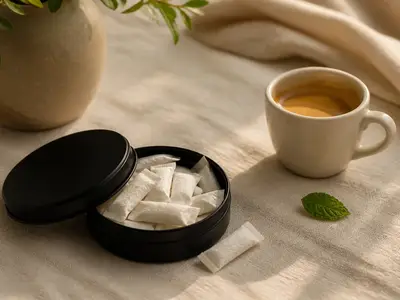
A caffeine pouch is a small, tobacco-free, nicotine-free pouch placed between the gum and cheek. It releases caffeine (and, in some products, additional ingredients such as L-theanine, B vitamins and Citicoline) so that part of the dose is absorbed through the lining of the mouth rather than only through the stomach.
Available evidence suggests this route can produce a quicker onset than a beverage, so some people report feeling the effect within roughly 10–30 minutes. Importantly, a faster onset does not mean a stronger or safer dose — it simply means the same amount of caffeine may arrive a little sooner. For a deeper look at the format, see the science behind caffeine pouches.
How Much Caffeine Is Too Much? Counting Your Total Dose
This is the single most important practical point, and it is easy to overlook. The 400 mg/day guidance is a ceiling for caffeine from all sources combined — not per product.
That means a pouch is never consumed in isolation. To stay within safe limits, add together the caffeine from everything you take in on a given day, for example:
- Caffeine pouches — about 50 mg each
- Coffee — roughly 95–120 mg per standard cup
- Tea — often around 30–50 mg per cup
- Cola and other soft drinks — commonly 30–40 mg per can
- Energy drinks — frequently 80 mg and often much more per can
- Pre-workout supplements — sometimes 150–300 mg per serving
Two pouches (100 mg) look harmless on their own, but combined with three cups of coffee and a pre-workout, the daily total can climb past the 400 mg guidance quickly. If you tend to reach for caffeine reactively, our guide on caffeine tolerance and how to avoid it explains why creeping up your dose often backfires. For a direct format comparison, see caffeine pouches vs coffee.
Caffeine and Sleep: Why Timing Matters
Because caffeine has a half-life of roughly 4–6 hours, a meaningful portion of an afternoon dose can still be in your system at bedtime. A pouch taken at 5 pm may leave a quarter or more of its caffeine circulating well past 9 pm, which is enough to delay sleep onset or reduce sleep quality for many people — even if you do not consciously feel "wired".
A simple, non-alarmist rule helps: favour caffeine earlier in the day, and give yourself a cut-off in the afternoon or early evening based on your own sensitivity. If you use caffeine to get through late or overnight hours, see our night shift caffeine guide for a practical timing plan.
What "Safe" Does Not Mean
A few honest clarifications keep expectations realistic:
- Nicotine-free does not mean risk-free. Being free of nicotine and tobacco avoids nicotine dependence and its harms, but nicotine-free does not remove caffeine-related risks such as insomnia, palpitations, anxiety or overconsumption. If you are coming from nicotine pouches, see caffeine pouches without nicotine.
- Faster onset is not the same as stronger or better. A quicker feel-good effect can make it tempting to top up too soon; the total caffeine still counts.
- A low per-pouch dose is not a licence for unlimited use. Safety is about your daily total across every source, not the size of one serving.
- "Generally safe for most adults" is not the same as "safe for everyone". Individual health conditions change the picture (see below).
Who Should Be Cautious
For some people, caffeine pouches are best avoided or used only after speaking to a health professional. Be cautious — and get advice first — if any of the following apply:
- People with heart-rhythm problems (arrhythmias) or other cardiovascular conditions. Caffeine can raise heart rate and, in sensitive individuals, contribute to palpitations.
- People prone to anxiety or panic symptoms. Caffeine can amplify a racing heart, jitteriness and a sense of unease.
- Anyone taking stimulant medication or other drugs that interact with caffeine — check with your prescriber or pharmacist.
- People who are pregnant or breastfeeding. EFSA advises limiting caffeine to about 200 mg per day from all sources during pregnancy.
- People who are highly caffeine-sensitive. Genetic differences in how quickly caffeine is metabolised mean some people feel strong effects from small amounts.
- Under-18s. Caffeine pouches are intended for adults only.
Possible Side Effects and How to Reduce Them
At around 50 mg, side effects are uncommon in healthy adults, but with any caffeine product, higher totals can cause restlessness or anxiety, a faster heartbeat, and difficulty sleeping if used late in the day. Some new users also notice mild, temporary gum sensitivity where the pouch sits.
The practical safeguards are straightforward: keep to a moderate number of pouches, count them toward your daily caffeine total, avoid late-day use, and do not stack several pouches at once. For a fuller, honest breakdown, see our guide to caffeine pouch side effects and what to expect, and for the specific gum question, whether caffeine pouches cause gum recession.
Frequently Asked Questions
Are caffeine pouches safe for daily use?
For most healthy adults, moderate daily use can fit within the EFSA guidance of up to 400 mg of caffeine per day from all sources. The key is to count pouches alongside every other caffeine source and to stay well under that ceiling.
Does nicotine-free mean caffeine pouches have no risks?
No. Being nicotine-free avoids nicotine dependence, but it does not remove caffeine-related risks such as insomnia, palpitations, anxiety or overconsumption. Those effects come from the caffeine itself.
How many caffeine pouches can I have in a day?
There is no single number that fits everyone, because it depends on your other caffeine sources and your sensitivity. A useful approach is to add up all your caffeine for the day and keep the total comfortably below 400 mg (or below 200 mg if pregnant).
Will a caffeine pouch keep me awake at night?
It can, if used later in the day. Caffeine's 4–6 hour half-life means an afternoon or evening pouch may still affect sleep, so an earlier cut-off is sensible.
Is the evidence on caffeine pouches strong?
The evidence on caffeine as a substance is strong; direct, long-term evidence on the pouch format specifically is more limited. Current evidence suggests the format is a reasonable way to take a measured dose, but format-specific claims should be read with that caveat.
The Bottom Line
For healthy adults, a 50 mg caffeine pouch is a modest, measured dose that sits comfortably within established caffeine-safety limits when your daily total is kept in check. It is not categorically safer or riskier than coffee or an energy drink — it is simply a portable, low-sugar way to take a controlled amount of caffeine, better suited to certain situations than others. The real determinants of safety are your total daily caffeine, the timing, your health status and your individual sensitivity.
This article is for general information only and is not medical advice. It is not a substitute for guidance from a physician, pharmacist or other qualified health professional. If you have a health condition, are pregnant or breastfeeding, or take medication, speak to a professional before using caffeine products.
If a portable, controlled 50 mg caffeine format fits your routine, explore Revimit's nicotine-free pouches. If it does not, that is fine too — the right amount of caffeine is the amount that works for you.