

Home / The Charge / health
healthThe Science Behind Caffeine Pouches: How They Actually Work
How do caffeine pouches work? A calm, evidence-layered look at the buccal-absorption science, what is proven, what is inferred, and where research is limited.
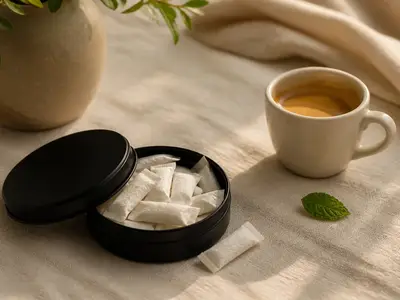
Caffeine pouches are small, tobacco-free sachets held between the gum and upper lip, where a portion of the caffeine is absorbed directly through the lining of the mouth rather than being swallowed and processed by the stomach. This buccal route is what makes the format distinct from coffee or an energy drink. To judge how they actually work — and how much of the popular explanation is solid science versus reasonable inference — it helps to separate the evidence into layers, from what is firmly established about caffeine to what remains specific to the pouch itself.
This article is deliberately structured around that distinction. Established caffeine pharmacology can be stated plainly. Claims that are specific to pouches as a delivery format deserve more caution, because the direct research base for them is thinner. Keeping the two apart is the honest way to answer the question.
Layer One: What Is Well Established About Caffeine
The first layer is the science that does not depend on the pouch format at all. Caffeine is one of the most studied psychoactive compounds in the world, and its core mechanism is not in serious dispute.
Caffeine works primarily as a competitive adenosine receptor antagonist. Adenosine is a signalling molecule that accumulates in the brain during waking hours and promotes feelings of tiredness by binding to A1 and A2A receptors. Caffeine has a similar molecular shape and occupies those receptors without activating them, temporarily blunting the fatigue signal. This is why caffeine reduces perceived tiredness and supports alertness rather than adding energy in any literal sense.
The dose-related effects are also well documented in the caffeine pharmacology literature. At modest doses in the region of 40–75 mg, controlled studies have repeatedly found small but measurable improvements in reaction time, vigilance and sustained attention in healthy adults. A single caffeine pouch typically contains around 50 mg — roughly half a small cup of brewed coffee, which sits near 95–120 mg. In practical terms, that places one pouch within a well-characterised, low-to-moderate dose range rather than anything unusual.
Safety thresholds are equally established at the regulatory level. The European Food Safety Authority concluded that intakes up to about 400 mg of caffeine per day are unlikely to raise safety concerns for most healthy adults, with single doses of around 200 mg generally not a concern (EFSA, 2015). Caffeine's half-life in a typical adult is roughly 4–6 hours, which is why late-day use can interfere with sleep regardless of how it is delivered. None of this depends on whether the caffeine arrives from a cup, a tablet or a pouch.
How Caffeine Is Absorbed Through the Mouth
The mouth's inner lining, the buccal mucosa, is a thin and richly supplied tissue, and it is a recognised route for delivering some drugs into the bloodstream. Buccal absorption can bypass the stomach and the first pass through the liver for the fraction of a compound that crosses the mucosa directly. This general principle is supported by buccal-absorption research and by the pharmacology of medications formulated for oral-mucosal delivery.
Applied to caffeine, this means that some of the caffeine in a pouch can enter circulation through the gum and lip lining, while the remainder is swallowed with saliva and absorbed conventionally through the gut. So a pouch is realistically a mixed delivery route rather than a pure buccal one. That nuance matters for the claims in the next layer, because it tempers how much faster or how different the experience can honestly be said to be.
Layer Two: What We Can Reasonably Infer About Pouches
The second layer covers plausible implications of the pouch format. These are reasonable inferences from the mechanism and from adjacent research, but they are not settled facts specific to caffeine pouches, so they are stated with appropriate caution.
- Onset may feel somewhat faster than a drink for some users. Because part of the dose can bypass gastric emptying, available evidence on buccal and chewing-gum caffeine delivery suggests a potentially quicker rise in blood caffeine than swallowing the same amount. How large that difference is in practice, and how much it varies between individuals, is not precisely established for pouches specifically.
- Onset speed is not the same as strength. A faster-feeling start does not mean a bigger or better effect. A 50 mg dose remains a 50 mg dose whatever the delivery timing.
- No sugar means no separate sugar crash. Many energy drinks pair caffeine with 20–30 g of sugar, which can produce its own short glucose spike and subsequent dip. A sugar-free pouch avoids that layered effect, so any comedown is driven by caffeine clearance alone rather than blood-sugar swings. This is a straightforward consequence of the ingredients, not a special property of pouches.
- Dose control may feel more consistent. A fixed 50 mg per pouch is easier to count than a variable cup of coffee, which can help some people manage total daily intake — though this is a convenience point, not a physiological advantage.
Phrases like "cleaner" or "smoother" that circulate in marketing should be read as subjective user descriptions. There are plausible mechanistic reasons some people report them, but they are not, on current evidence, proven format-wide claims.
Evidence Gaps
Honesty requires stating clearly where the evidence runs out. Most of what is known about caffeine comes from studies using coffee, capsules, tablets or chewing gum — not commercial caffeine pouches. Direct, long-term research on caffeine pouches as a specific product category is limited.
In particular, there is little published data on the exact proportion of caffeine absorbed buccally versus swallowed from a modern pouch, on long-term daily use of pouches specifically, and on how the format performs across different age groups, oral-health states and individual metabolic rates. There is also limited direct research comparing the subjective "feel" of pouches against drinks under controlled conditions. Where this article describes format-specific effects, it is extrapolating from established caffeine science and related delivery research rather than citing pouch-specific long-term trials, because those trials are not yet abundant. Readers should weigh the format claims accordingly.
What This Does Not Mean
A faster or more convenient delivery route does not make caffeine pouches categorically superior to coffee, tea or energy drinks. It makes them potentially better suited to certain situations — a quick focus window before a meeting, a sugar-free option during fasting, or discreet use where a drink is impractical. For someone who enjoys the ritual of coffee or wants a warm drink, a pouch is simply a different tool.
It is also important to be clear that caffeine-free of nicotine does not mean free of all risk. Pouches avoid nicotine and its dependence potential, but caffeine itself can still cause insomnia, a racing or pounding heartbeat, restlessness, anxiety and dependence-like withdrawal headaches if overused. The absence of sugar and nicotine narrows the risk profile; it does not eliminate it. More caffeine, delivered faster, is not automatically better, and it is easy to under-count total intake when a pouch feels effortless.
The Rationale Behind Revimit's Formulation
The third layer is where a specific product's design choices sit, and it should be read as formulation rationale rather than proof of superiority. Revimit's nicotine-free, tobacco-free pouches deliver 50 mg of natural caffeine each, with zero sugar, alongside B-vitamins (B3, B6 and B12), in tins of 20.
The choice of 50 mg is deliberate: it sits in the low-to-moderate range where the alertness benefits of caffeine are documented while leaving room to stay comfortably under the 400 mg daily guidance across several pouches. The B-vitamins are included as supporting nutrients associated with normal energy metabolism; they are not stimulants and should not be expected to produce a caffeine-like "hit". None of this turns a pouch into something more powerful than a modest, precisely dosed amount of caffeine — and that restraint is the point.
A note on L-theanine: it is a well-studied pairing partner for caffeine in nutrition research, and we cover what that combination does and does not do in a separate article on L-Theanine and Caffeine: The Science Behind the Combination. Revimit's current formulation does not contain L-theanine — the pairing is a research topic we follow, not an ingredient we use. If you are new to the format itself, the plain-English overview in What Are Caffeine Pouches? The Complete Beginner's Guide is a good starting place.
Practical Guidance for Using Caffeine Pouches
- Start with one. A single 50 mg pouch is enough to gauge your response, especially if you are not a habitual caffeine user.
- Count your whole day. Add pouches to any coffee, tea, cola or pre-workout you also consume, and keep the total comfortably within about 400 mg for a healthy adult.
- Mind the clock. Because caffeine's half-life is several hours, avoid using pouches within roughly 6–8 hours of bedtime if you are sleep-sensitive.
- Give it time before topping up. A faster-feeling onset can tempt early re-dosing; wait to feel the first pouch fully before adding another.
- Hold it, don't chew or swallow it. Keep the pouch tucked against the gum and remove it after use.
Who Should Be Cautious
Caffeine is not right for everyone, and the convenience of a pouch does not change who should take care. Speak to a qualified professional before use if any of the following apply:
- Pregnancy or breastfeeding: lower caffeine limits are generally advised, so professional guidance matters.
- Cardiovascular conditions: including arrhythmias, palpitations or uncontrolled high blood pressure, where stimulants can be a concern.
- Anxiety or panic sensitivity: caffeine can amplify restlessness, a racing heart and anxious feelings.
- Caffeine sensitivity: some people react strongly even to modest doses.
- Anyone taking stimulant or other interacting medication: caffeine can interact with several drugs.
- Under-18s: caffeine pouches are intended for adults.
The Types of Evidence This Article Relies On
Rather than cite individual papers, it is more useful to describe the kinds of sources behind the claims above, because that reveals where confidence is high and where it is provisional.
- Regulatory safety reviews, most notably the European Food Safety Authority's assessment of caffeine, underpin the dose thresholds (the roughly 400 mg daily and 200 mg single-dose figures).
- Core caffeine pharmacology literature supports the adenosine-antagonism mechanism, the half-life range and the documented effects on alertness and reaction time at low-to-moderate doses.
- Buccal- and oral-mucosal-absorption research, including work on caffeine delivered via chewing gum, informs the general principle that some caffeine can enter the bloodstream through the mouth and bypass gastric processing.
What is deliberately absent is a body of long-term trials on commercial caffeine pouches specifically, as noted in the evidence-gaps section. Where this article makes format-level claims, it is reasoning from these established source types rather than from pouch-specific long-term data.
Frequently Asked Questions
How do caffeine pouches actually work?
A pouch held against the gum releases caffeine, some of which is absorbed through the lining of the mouth into the bloodstream while the rest is swallowed and absorbed through the gut. The caffeine then acts on adenosine receptors in the brain to reduce perceived fatigue, exactly as caffeine from any source does.
Are caffeine pouches really faster than coffee?
They may feel somewhat faster for some people, because part of the dose can bypass the stomach. The size of that advantage is not precisely established for pouches specifically, and faster onset does not mean a stronger effect.
Is 50 mg of caffeine enough to do anything?
Yes. Controlled studies find measurable improvements in alertness and reaction time in the region of 40–75 mg for many adults. A 50 mg pouch sits in that low-to-moderate range.
Does the science on pouches specifically actually exist?
The science on caffeine is extensive, but direct long-term research on caffeine pouches as a product category is limited. Much of what is said about the format is reasonable inference from caffeine pharmacology and buccal-absorption research rather than pouch-specific trials.
Do the added ingredients make the effect stronger?
Not in a stimulant sense. The B-vitamins (B3, B6 and B12) in Revimit pouches are supporting nutrients associated with normal energy metabolism, not stimulants — the alertness effect comes from the 50 mg of caffeine. For a fuller safety picture, see Are Caffeine Pouches Safe? What the Science Says.
_This article is for general information only and is not medical advice. It is not a substitute for guidance from a physician, pharmacist or other qualified health professional. If you have a health condition, are pregnant or breastfeeding, or take medication, speak to a professional before using caffeine products._
If a portable, controlled 50 mg caffeine format fits your routine, explore Revimit's nicotine-free pouches. If it does not, that is fine too — the right amount of caffeine is the amount that works for you.