

Home / The Charge / lifestyle
lifestyleWhat Are Caffeine Pouches? The Complete Beginner’s Guide
A beginner's guide to caffeine pouches: what they are, how buccal absorption works, how strong the evidence really is, the downsides, and who should take care.
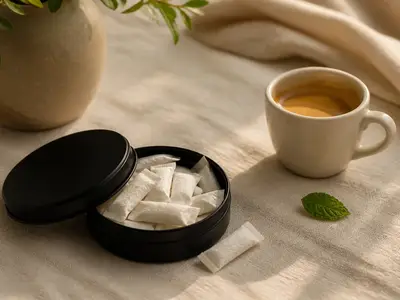
A caffeine pouch is a small, pre-portioned packet — similar in appearance to a nicotine pouch or snus — that you tuck between your upper lip and gum to deliver a measured dose of caffeine. It contains no tobacco and no nicotine. Instead of being swallowed, the caffeine is absorbed through the lining of the mouth, which is why people are increasingly reaching for them in gyms, offices and university libraries.
This guide explains what caffeine pouches are, how the delivery mechanism works, how strong the evidence behind them actually is, the potential downsides, and who should be careful — before looking at what a typical pouch contains.
What Is a Caffeine Pouch?
A caffeine pouch is a small fibre packet containing caffeine, flavourings and, in many products, additional active ingredients. It contains no tobacco and no nicotine, which is the key difference from the nicotine pouches it physically resembles.
You place it between your upper lip and gum and leave it there for roughly 15–30 minutes. During this time, caffeine is absorbed through the buccal mucosa — the mucous membrane lining the inside of your cheek — into the bloodstream, partly bypassing the digestive system. Because there is nothing to brew, spill or swallow, a pouch can be a low-sugar, portable way to use caffeine.
The Science of Buccal Absorption
The buccal route of administration is well established in pharmacology. The oral mucosa has a rich blood supply and is permeable to small lipophilic molecules — and caffeine qualifies. This is why buccal delivery is already used for some medications that need a fast onset.
When you drink coffee or an energy drink, caffeine passes through the stomach and small intestine before entering circulation, with peak blood concentration typically reached in 45–60 minutes (Blanchard & Sawers, _Journal of Pharmacokinetics and Biopharmaceutics_, 1983). Absorbing part of the dose through the mouth can shorten that window. A 2025 pharmacology piece by Dr Dipa Kamdar of Kingston University, published in _The Conversation_, describes the mechanism: _"Slip one under your lip and the caffeine goes straight into the bloodstream through your gums – bypassing the digestive system. The result? A jolt of energy that lands far quicker than a cup of coffee or tea."_
How Direct Is the Evidence on Caffeine Pouches?
This is where honesty matters. The evidence for caffeine as a substance is extensive: its pharmacology, safe intake levels and cognitive effects have been studied for decades. The evidence for buccal and oral drug delivery as a route is also well established. But much of what is said about caffeine _pouches specifically_ is extrapolated from those two bodies of science rather than drawn from a large set of long-term, pouch-specific clinical trials. There is limited direct research on this exact format so far.
In practice that means we can state caffeine facts plainly, and we can reasonably infer that some caffeine is absorbed buccally, but claims about precise onset speed or a "smoother" feel should be read as informed expectations rather than settled fact. Compared with coffee, a pouch may feel more convenient and more predictable for some users — but faster onset is not the same as a stronger effect, and it is not automatically better for everyone. If you want a deeper look at the mechanism, see The Science Behind Caffeine Pouches: How They Actually Work.
How Much Caffeine Is Safe?
For healthy adults, the European Food Safety Authority recommends a maximum of 400 mg of caffeine per day, with single doses of up to 200 mg considered safe for most people (EFSA Panel, 2015). For reference, a typical cup of coffee contains roughly 95–120 mg, and caffeine has a half-life of about 4–6 hours, meaning a late-day dose can still be in your system at bedtime.
A single 50 mg pouch sits comfortably below these limits, but pouches are easy to use repeatedly, so it helps to count them the way you would count cups of coffee — and to remember any other caffeine you have had that day. For a fuller safety picture, see Are Caffeine Pouches Safe? What the Science Says.
Potential Downsides
Caffeine pouches are not risk-free, and a beginner should know the trade-offs before starting:
- Gum irritation. Holding a pouch against the same spot repeatedly can cause localised soreness or irritation of the gum. Rotating the placement and not leaving pouches in longer than needed helps reduce this.
- Sleep disruption. Because caffeine lingers for hours, using pouches in the afternoon or evening can delay or fragment sleep — the same problem as late coffee.
- Accidental overuse. Pouches are discreet and easy to reach for, which makes it simple to lose count and drift over a sensible daily total without noticing.
- Stacking with other caffeine. Combining pouches with coffee, tea, energy drinks or pre-workout adds up quickly and is a common route to jitters, a racing heart or anxiety. Track your _total_ caffeine, not just the pouches.
None of these are unique to pouches — they are caffeine effects. But the convenient format can make it easier to overdo it. For a detailed rundown, see Caffeine Pouch Side Effects: What to Expect (An Honest Guide).
How to Use a Caffeine Pouch
- Take one pouch from the tin.
- Place it between your upper lip and gum — either side works.
- Leave it for 15–30 minutes; you may feel a mild tingling as the ingredients absorb.
- Remove and discard — do not swallow it.
Effects typically begin within 10–15 minutes and last around 1–3 hours. Start with one pouch to gauge your response, keep your last one well before bedtime, and give your gums a rest by moving the placement around.
What's Inside a Revimit Caffeine Pouch?
Formulations vary between brands. As one example, Revimit pouches are designed for steady rather than spiky energy, and each pouch contains:
- 50 mg natural caffeine — a moderate, controlled dose, roughly half a cup of coffee.
- B vitamins (B3, B6 and B12) — which support normal energy metabolism.
- A plant-fibre base and flavouring — sugar-free, zero calories, no sweetener load.
- No nicotine, no tobacco, no sugar — the formula is deliberately simple.
Some brands add other ingredients such as L-theanine or citicoline to their pouches. Revimit's current formulation does not — the effect comes from a precisely dosed amount of caffeine, with B-vitamins as supporting nutrients. If you are curious about the caffeine and L-theanine pairing as a research topic, we cover what it does and does not do in L-Theanine and Caffeine: The Science Behind the Combination. If you are choosing between formats, Caffeine Pouches vs Coffee: Which One Is Better for Your Energy? compares them directly.
Who Should Be Cautious
Caffeine pouches are not suitable for everyone. You should be cautious, or avoid them entirely, if you are in any of the following groups:
- Pregnant or breastfeeding — lower caffeine limits apply; seek professional advice.
- People with cardiovascular conditions, including arrhythmias or high blood pressure.
- People prone to anxiety or panic, as caffeine can heighten these feelings.
- Anyone who is caffeine-sensitive and reacts strongly to small amounts.
- Anyone taking stimulant medication or other drugs that interact with caffeine.
- Under-18s, for whom caffeine pouches are not recommended.
Evidence Used in This Article
This article draws on a small number of source types rather than a single trial. Safe-intake guidance comes from a food-safety authority opinion (EFSA, 2015). The absorption timing draws on pharmacokinetic research into caffeine (Blanchard & Sawers, 1983) and on general pharmacology of buccal drug delivery. A 2025 pharmacology explainer in _The Conversation_ describes the pouch mechanism and its trade-offs. Where a point relies on established caffeine science we state it plainly; where it is specific to the pouch format, we have hedged, because direct long-term research on pouches themselves remains limited.
Frequently Asked Questions
Are caffeine pouches addictive?
Caffeine produces physical dependence with regular use, and this applies equally to coffee, tea and pouches. Gradually reducing intake helps avoid withdrawal effects such as headache and fatigue.
Do caffeine pouches stain teeth?
They generally do not, because they lack the chromogens in coffee and tea that are responsible for tooth staining. They can, however, irritate the gums if kept in one spot for too long.
Can I use a caffeine pouch at work?
Yes. They are discreet, odourless and need no equipment, which is why many people use them in meetings, on calls or while commuting.
How many caffeine pouches can I have in a day?
There is no single answer, but a practical approach is to keep your total caffeine from all sources under the 400 mg adult daily guidance, and lower if you are sensitive. Count pouches alongside any coffee, tea or energy drinks.
Is caffeine buccally absorbed faster than from coffee?
Absorbing part of the dose through the mouth can bring on effects sooner than swallowing it, but the exact difference is not firmly quantified for pouches, and faster onset does not mean a stronger effect.
_This article is for general information only and is not medical advice. It is not a substitute for guidance from a physician, pharmacist or other qualified health professional. If you have a health condition, are pregnant or breastfeeding, or take medication, speak to a professional before using caffeine products._
If a portable, controlled 50 mg caffeine format fits your routine, explore Revimit's nicotine-free pouches. If it does not, that is fine too — the right amount of caffeine is the amount that works for you.