

Home / The Charge / energy
energyHow Long Do Caffeine Pouches Last? Effects & Duration
How long do caffeine pouches last? Keep the pouch in 20-40 minutes; the caffeine effect tapers over several hours as its 4-6 hour half-life clears.
There are really two questions hiding inside “how long do caffeine pouches last?” The first is how long you keep the pouch in your mouth — usually around 20 to 40 minutes. The second is how long the caffeine itself keeps working — typically several hours, because caffeine has a half-life of roughly 4 to 6 hours and leaves the body gradually. Those are separate things, and confusing them is where most of the uncertainty comes from.
How Long You Keep the Pouch in Your Mouth
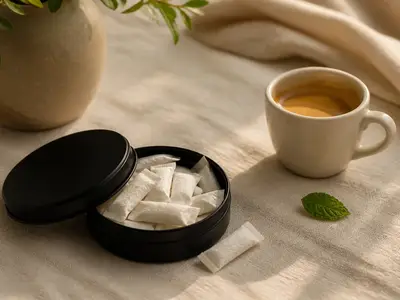
A caffeine pouch sits between your gum and upper lip, and caffeine passes across the lining of your mouth into the bloodstream — a route called buccal absorption. Most of that transfer happens fairly early: keeping a pouch in for about 20 to 40 minutes is generally enough for the bulk of the caffeine to be released.
Leaving it in much longer does not add a great deal, because once the pouch has given up most of its caffeine there is little left to absorb. Many people notice a light tingling that fades over time; when it settles, the active release phase is largely over. There is no strict rule here — the mouth-time is about comfort and getting the dose out, not about extending the effect.
How Long the Caffeine Effect Lasts
This is the part most people actually mean. Once caffeine is in your bloodstream, its half-life — the time your body takes to clear half of it — is approximately 4 to 6 hours in healthy adults, though this varies considerably from person to person (Nehlig, 2010). A noticeable lift usually lasts a few hours, then tapers rather than switching off.
The important consequence of that half-life: several hours after your last dose, a meaningful amount of caffeine is still circulating. If you have 50 mg in the early afternoon, a portion is still in your system that evening. That matters far more for sleep than the format the caffeine came in.
Onset: why buccal delivery can feel quicker
When you drink coffee, caffeine is absorbed through the digestive tract, and it can take roughly 30 to 60 minutes to feel the full effect (Nehlig, 2010). Caffeine absorbed across the lining of the mouth can enter the bloodstream sooner: a study of caffeine delivered in chewing gum found measurable rises in plasma caffeine within about 10 to 15 minutes (Kamimori et al., 2002). That study used gum rather than pouches, so it is reasonable evidence for the buccal route in general, but there is limited direct research on caffeine pouches specifically, and how quickly any individual feels it depends on their own physiology. In short, buccal delivery may feel faster to come on than swallowing — treat any precise minute-by-minute claim as an estimate, not a guarantee.
What a Faster Onset Does Not Mean
A quicker onset is easy to over-interpret, so it is worth being clear about what it does and does not tell you:
- Faster is not stronger. How soon caffeine arrives does not change how much you took. A 50 mg pouch delivers 50 mg whether it feels quick or slow.
- Faster is not longer-lasting. Onset and duration are governed by different things; a quick start does not mean the effect outlasts a coffee.
- Faster is not universally better. For some situations a slower, gentler rise is preferable, and coffee or tea may suit you just as well.
- Pouches are not automatically superior to coffee, tea or energy drinks. They are simply a different, portable way to take caffeine that can be more convenient in some settings.
The underlying compound is the same caffeine in every case. The format changes the delivery and the convenience, not the pharmacology.
What Changes How Long It Lasts for You
“How long does it last?” genuinely has a different answer for different people. The main factors:
- Genetics. Variants in the CYP1A2 enzyme, which breaks caffeine down, mean some people clear it much faster than others (Cornelis et al., 2006).
- Tolerance. Regular caffeine users often feel a shorter, milder effect for the same dose. If that is happening to you, our guide to Caffeine Tolerance: How to Avoid It and Keep the “Kick” Alive is a useful next read.
- Body size and metabolism. These influence both how strong the effect feels and how quickly it fades.
- Sleep and stress. When you are short on sleep, caffeine can feel more pronounced and seem to last longer.
- Pregnancy, liver health and certain medications. These can substantially slow caffeine clearance, meaning it stays active far longer than usual.
If you want the underlying mechanism in more depth, see The Science Behind Caffeine Pouches: How They Actually Work.
Timing Caffeine Around Sleep
Because caffeine lingers, timing is the single most practical thing you can control. Given a half-life of roughly 4 to 6 hours, caffeine taken in the late afternoon or evening can still be affecting you at bedtime, potentially delaying sleep onset or reducing sleep quality — even if you feel able to fall asleep.
Some sensible, non-alarmist guidance:
- Front-load your caffeine. Morning and early afternoon are the safest windows for most people.
- Leave a buffer before bed. If you are sensitive, giving yourself several hours — many people use six or more — between your last dose and bedtime is a reasonable habit.
- Watch your daily total. The European Food Safety Authority considers up to 400 mg of caffeine a day safe for most healthy adults, and single doses up to about 200 mg unlikely to cause concern (EFSA, 2015). Count every source — coffee, tea, cola and pouches all add up.
- Judge by your own sleep, not the clock alone. If your sleep suffers, move your cut-off earlier.
Who Should Be Cautious
Being nicotine-free and tobacco-free does not make caffeine risk-free. Caffeine is an active stimulant and can still cause insomnia, a racing heart, palpitations, anxiety or jitteriness, especially at higher doses. Some people should be more careful, or should speak to a health professional first:
- Pregnant or breastfeeding people — caffeine is cleared more slowly in pregnancy and lower limits usually apply.
- People with cardiovascular conditions, including arrhythmias or high blood pressure.
- Anyone prone to anxiety or panic, as caffeine can amplify those feelings.
- People who are caffeine-sensitive, who may feel strong or long-lasting effects from small amounts.
- Anyone taking stimulant or other interacting medication — check with a pharmacist or doctor.
- Under-18s, for whom higher caffeine intake is generally not advised.
Frequently Asked Questions
How long should I keep a caffeine pouch in my mouth?
Around 20 to 40 minutes is typical, as most of the caffeine is released within that window. You can remove it sooner if you prefer; leaving it in much longer adds little.
How long do the effects of a caffeine pouch last?
A noticeable lift usually lasts a few hours, then tapers gradually because caffeine has a half-life of roughly 4 to 6 hours. The exact duration varies from person to person.
Do caffeine pouches work faster than coffee?
Caffeine absorbed through the lining of the mouth can enter the bloodstream sooner than caffeine you swallow, so it may feel quicker. However, direct research on pouches specifically is limited, and individual experience varies.
Will an afternoon caffeine pouch affect my sleep?
It can. With a half-life of several hours, caffeine taken in the afternoon or evening may still be active at bedtime. If you are sensitive, leave several hours between your last dose and sleep.
Does a faster onset mean a stronger effect?
No. How quickly caffeine arrives does not change the dose. A faster onset is not the same as a stronger, longer or better effect.
Practical Takeaway
Keep the pouch in for roughly 20 to 40 minutes to release the caffeine; expect the effect itself to build over the first hour and taper across the following several hours, in line with caffeine’s 4-to-6-hour half-life. The buccal route may feel quicker to come on than a swallowed drink, but the dose and the pharmacology are the same caffeine you already know. The lever that matters most is timing — especially how close to bedtime you take your last dose. If you are new to the format entirely, start with our beginner overview, What Are Caffeine Pouches? The Complete Beginner’s Guide.
This article is for general information only and is not medical advice. It is not a substitute for guidance from a physician, pharmacist or other qualified health professional. If you have a health condition, are pregnant or breastfeeding, or take medication, speak to a professional before using caffeine products.
If a portable, controlled 50 mg caffeine format fits your routine, explore Revimit's nicotine-free pouches. If it does not, that is fine too — the right amount of caffeine is the amount that works for you.