

Home / The Charge / energy
energyCaffeine Pouches vs Pre-Workout: Which Is Better for Your Training?
Caffeine pouches vs pre-workout: an honest comparison of dose, timing and sleep, when each suits training, and how to stack both without overdoing caffeine.
Pre-workout supplements and caffeine pouches answer two different questions. A pre-workout is a multi-ingredient formula built to maximise a single hard training session, while a caffeine pouch is a small, portable dose of caffeine you can use across the day. For many recreational gym-goers a pouch covers most training needs, but a pre-workout still has a real place for deliberate high-intensity work. This is an honest comparison of what each format actually does.
What's Actually in Pre-Workout?
Most pre-workout formulas combine stimulants, amino acids and other compounds intended to support performance in a single session. A typical scoop includes:
- Caffeine: usually 150–300 mg per serving, sometimes more
- Beta-alanine: the ingredient behind the characteristic skin tingling, studied mainly for high-rep muscular endurance
- Creatine: useful for strength, but it works through consistent daily intake rather than an acute pre-session dose
- L-citrulline: included for blood flow and "pump"
- B vitamins, taurine, electrolytes: varies widely by brand
The value of a pre-workout is that stack, not the caffeine alone. The trade-off is the caffeine dose: many pre-workouts deliver 200–300 mg in one serving — roughly four to six times the caffeine in a single 50 mg pouch. That can be appropriate before a hard, planned session, but it is a large fixed stimulant load that stays with you for hours.
What's in a Caffeine Pouch?
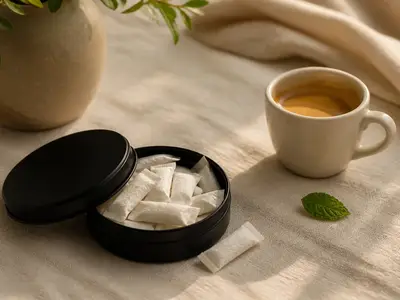
A caffeine pouch is a small, tobacco-free, nicotine-free pouch placed between the gum and cheek. Revimit pouches contain 50 mg of natural caffeine each, plus B-vitamins (B3, B6 and B12), with no sugar. Some brands also add L-theanine or other nootropic-style ingredients; Revimit's current formulation does not.
The main practical difference is the delivery route. Caffeine is absorbed through the oral mucosa (buccal absorption), which bypasses the digestive system and can give a faster onset than swallowing a capsule — research on caffeine chewing gum suggests effects within roughly 10–20 minutes (Kamimori et al., 2002). There is limited direct research on caffeine pouches specifically, so it is fair to treat the buccal-caffeine evidence as indicative rather than exact. In use, it means no mixing, no water and no waiting for a drink to absorb.
Pouch vs Pre-Workout: The Honest Comparison
1. Caffeine dose
Pre-workout typically provides 150–300 mg per serving as a fixed amount; a pouch provides 50 mg you can titrate (one pouch, or two for 100 mg). Neither is "better" in the abstract. A large single dose may suit a planned high-intensity session, while a smaller controlled dose is easier to fit around work, evening training and everyday use.
2. Post-stimulant fatigue
A large, fast caffeine spike is often followed by a noticeable drop. A 2022 review in the _Journal of the International Society of Sports Nutrition_ reported that post-stimulant fatigue was among the more commonly reported effects of pre-workout use (Jagim et al., 2022). Separately, the caffeine + L-theanine combination (used in some products) has been studied for a smoother subjective effect: randomised trials including Owen et al. (2008) and Giesbrecht et al. (2010) found that caffeine with L-theanine supported alertness with, in some measures, less of the jittery edge than caffeine alone. That is research about the combination in general — it is not a claim that any pouch abolishes a "crash", and Revimit's current formulation does not contain L-theanine.
3. Timing and sleep
Caffeine has a half-life of roughly 4–6 hours, so a 250 mg pre-workout taken at 6 pm can still have a meaningful amount circulating near midnight. Training late in the day is where a large stimulant dose most often disrupts sleep, and lost sleep undermines the recovery that training is meant to drive. A smaller 50 mg dose is easier to place earlier in its clearance curve, though it is still caffeine and can still affect sleep if used too close to bedtime.
4. Side effects
Beta-alanine commonly causes paraesthesia (harmless skin tingling), and high caffeine doses can cause anxiety, a raised heart rate and gastrointestinal discomfort in sensitive users. At 50 mg, caffeine side effects are less common in healthy adults; the most frequently reported pouch complaint is mild, short-lived gum sensitivity. Lower dose does not mean risk-free — see the cautions below.
5. Convenience
A pre-workout needs a shaker, water and clean-up, and a tub of powder is awkward to travel with. A pouch fits in a pocket and needs nothing else, which may feel more convenient for commuting, travel, outdoor sport or an early run. Convenience is a genuine advantage of the format, not evidence that it trains you harder.
When Pre-Workout May Make More Sense
A pouch is not a like-for-like replacement for a pre-workout, and there are situations where the full formula is the better tool:
- Deliberate high-intensity sessions — heavy strength work, sprint or interval training, or a peak competition effort, where you want the full stimulant load working with the rest of the stack.
- When you specifically want the non-caffeine ingredients. A caffeine pouch does not provide L-citrulline (studied for blood flow and pump) or beta-alanine (studied for high-rep muscular endurance), and it is not a creatine source. If your goal depends on those ingredients, a pouch will not stand in for them.
- Morning training, where a larger dose has all day to clear and the late-day sleep concern does not apply.
In short, a pouch replaces the _caffeine_ part of a pre-workout conveniently; it does not replace a multi-ingredient formula.
What a Caffeine Pouch Does NOT Do
To keep the comparison honest: a faster onset does not mean a stronger or universally better effect, and a smaller dose does not make caffeine harmless. A Revimit pouch delivers 50 mg of natural caffeine plus B-vitamins — it is not a performance stack, not a creatine or beta-alanine substitute, and not a guarantee against insomnia, palpitations or anxiety if you overuse it. It is best understood as a low-sugar, portable way to control your caffeine, better _for certain situations_ rather than better across the board.
Can You Stack Both Safely?
Some people are tempted to take a pre-workout and then add pouches during a long session or a busy day. This is where cumulative dose matters most. Many pre-workouts already deliver 200–300 mg of caffeine at once; adding two 50 mg pouches on top pushes you to 300–400 mg from those sources alone — before any coffee, tea or energy drink. The EFSA guideline for healthy adults is up to about 400 mg of caffeine per day, and single doses around 200 mg (EFSA, 2015), so stacking can reach the daily ceiling quickly.
Practical guidance if you use both:
- Count everything. Add up caffeine from the pre-workout, pouches, coffee, tea and any energy drinks across the whole day, not just around training.
- Don't double up on the same session. If a pre-workout already covers your session, you rarely need pouches on top of it.
- Use them on different days or different jobs. Many people reserve pre-workout for deliberate high-intensity training and use a pouch for lighter sessions, commuting or focused work.
- Mind the clock. The more stimulant you stack, the earlier in the day you should finish it to protect sleep.
If you find you keep needing more caffeine to feel the same effect, that is usually a tolerance signal rather than a reason to add another source — our guide on Caffeine Tolerance: How to Avoid It and Keep the "Kick" Alive covers how to reset instead of escalate.
Who Should Be Cautious
Regardless of format, some people should be careful with concentrated caffeine or avoid it:
- Pregnant or breastfeeding people, for whom EFSA advises a lower daily caffeine limit.
- Anyone with a cardiovascular condition, including arrhythmias or high blood pressure.
- People prone to anxiety or panic, since stimulants can amplify these feelings.
- Anyone particularly caffeine-sensitive, who may react even to modest doses.
- Anyone taking stimulant or other interacting medication — check with a pharmacist or doctor first.
- Under-18s, for whom high-caffeine pre-workouts and pouches are not appropriate.
For a fuller picture of the evidence on this format, see Are Caffeine Pouches Safe? What the Science Says, and if you are moving away from high-caffeine drinks, 5 Reasons to Switch From Energy Drinks to Caffeine Pouches.
Frequently Asked Questions
Can a caffeine pouch replace my pre-workout?
It can replace the caffeine part conveniently, but not the whole formula. A pouch does not contain citrulline, beta-alanine or creatine, so if you rely on those ingredients a pouch is not a substitute.
Is it safe to take a pouch on top of pre-workout?
Only if you track your total daily caffeine. Many pre-workouts already provide 200–300 mg, so adding pouches can push you close to or over the ~400 mg EFSA guideline for adults, especially once coffee and tea are included.
Which is better for evening training?
A smaller, controlled dose is generally easier to manage before evening sessions, because a large pre-workout dose taken late can still be active near bedtime. Any caffeine too close to sleep can be disruptive, so finish earlier when you can.
Will a pouch give me the same "pump" as pre-workout?
No. The pump many people notice comes largely from ingredients like L-citrulline, which pouches do not contain. A Revimit pouch provides caffeine and B-vitamins, not a pre-workout stack.
How many pouches equal a pre-workout dose of caffeine?
Roughly four to six 50 mg pouches would match a 200–300 mg pre-workout on caffeine alone, but taking that many at once is not the intended use and approaches daily caffeine limits quickly.
_This article is for general information only and is not medical advice. It is not a substitute for guidance from a physician, pharmacist or other qualified health professional. If you have a health condition, are pregnant or breastfeeding, or take medication, speak to a professional before using caffeine products._
If a portable, controlled 50 mg caffeine format fits your training routine, explore Revimit's nicotine-free pouches. If it does not, that is fine too — the right amount of caffeine is the amount that works for you.
References
- Kamimori GH, et al. _The rate of absorption and relative bioavailability of caffeine administered in chewing gum versus capsules._ Int J Pharm. 2002;234(1-2):159-167.
- Owen GN, et al. _The combined effects of L-theanine and caffeine on cognitive performance and mood._ Nutr Neurosci. 2008;11(4):193-198.
- Giesbrecht T, et al. _The combination of L-theanine and caffeine improves cognitive performance and increases subjective alertness._ Nutr Neurosci. 2010;13(6):283-290.
- Jagim AR, et al. _Common ingredient profiles of multi-ingredient pre-workout supplements._ Nutrients. 2019;11(2):254.
- Jagim AR, et al. _Safety of pre-workout supplements._ J Int Soc Sports Nutr. 2022;19(1).
- European Food Safety Authority. _Scientific Opinion on the Safety of Caffeine._ EFSA Journal. 2015;13(5):4102.