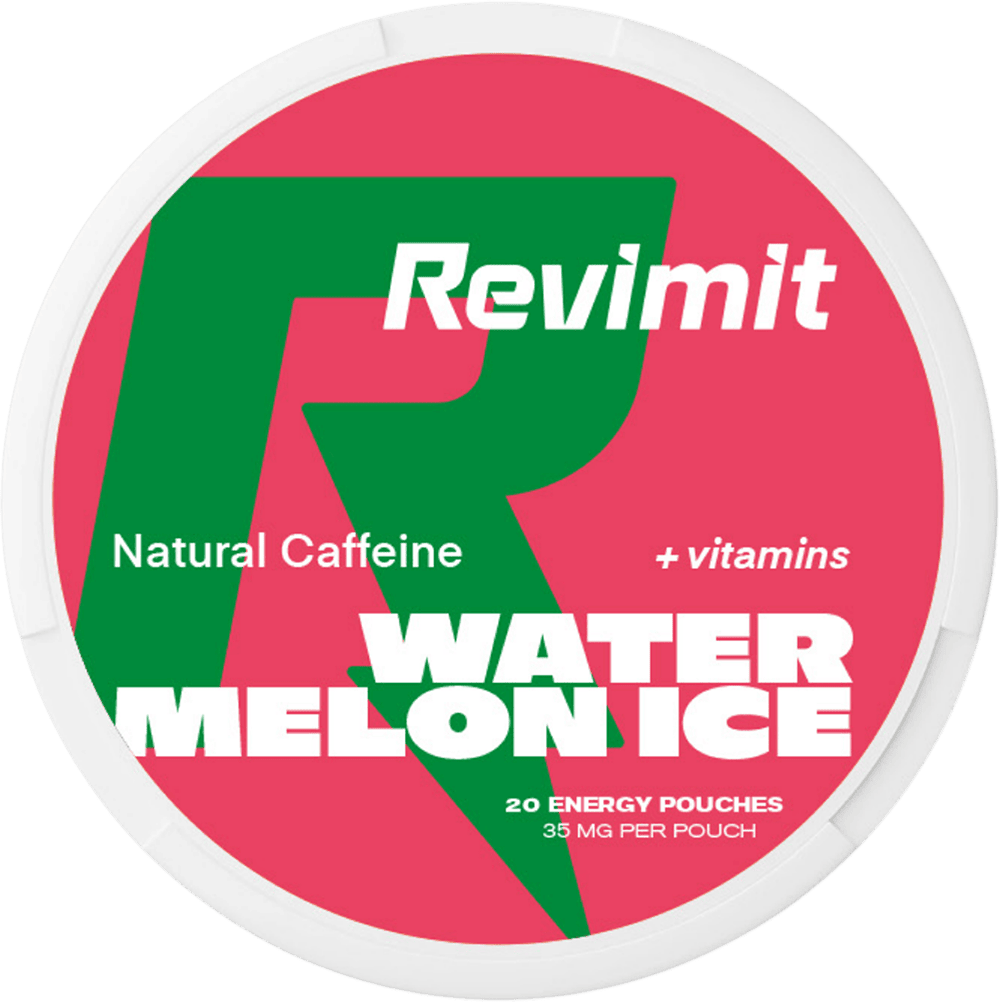
5 Reasons to Switch From Energy Drinks to Caffeine Pouches
Energy drinks are everywhere. They’re also one of the most researched — and most concerning — categories of beverages consumed today. If you rely on them for focus and energy, here’s what the science says about what they’re doing to your body, and why caffeine pouches are worth considering as a replacement.
1. Energy Drinks Are Engineered for Excess — Caffeine Pouches Are Engineered for Control
A standard 250ml can of Red Bull contains 80mg of caffeine. A 500ml Monster delivers 160mg. Some “extreme” energy drinks contain up to 300mg in a single can.
The European Food Safety Authority considers single doses above 200mg potentially problematic for some adults (EFSA, 2015, doi:10.2903/j.efsa.2015.4102). At these concentrations — combined with sugar and taurine — the cardiovascular load increases meaningfully.
Revimit pouches contain 50mg per pouch. That’s intentional. You control the dose precisely, and you’re well within safe limits at 1–2 pouches.
2. The Sugar Problem Is Bigger Than You Think
A 500ml energy drink can contain up to 54 grams of sugar — roughly 13 teaspoons. Even “sugar-free” versions use artificial sweeteners with their own contested health profiles.
A systematic review published in BMJ Open (Visram et al., 2016, doi:10.1136/bmjopen-2015-010380) linked regular energy drink consumption to dental erosion, obesity risk, and metabolic disruption — independent of the caffeine content. The sugar load alone is a significant health concern.
Revimit pouches are sugar-free, sweetened with xylitol and monk fruit. Xylitol is tooth-friendly and carries a glycaemic index of approximately 7 (compared to 65 for regular sugar).
3. The “Jolt and Crash” Is a Documented Phenomenon
Energy drink users frequently report a cycle of intense stimulation followed by a sharp energy drop. Researchers at the University of Minnesota formalized this as the “jolt and crash” effect — and found a dose-dependent relationship: the more energy drinks consumed in one session, the more severe the crash (Malinauskas et al., Nutrition Journal, 2007, doi:10.1186/1475-2891-6-35).
This happens because large caffeine doses cause a rapid spike in adenosine receptor blockade, followed by an equally rapid rebound when caffeine clears. High sugar content amplifies the effect through an independent glucose crash mechanism.
Caffeine pouches with L-theanine produce a measurably smoother energy curve. The L-theanine moderates the peak stimulation while maintaining alertness, reducing the amplitude of both the rise and the crash (Haskell et al., Nutritional Neuroscience, 2008, doi:10.1179/147683008X301513).
4. Energy Drinks and Cardiovascular Risk Are Linked
This is the point energy drink manufacturers least want discussed. A 2017 review in the Journal of the American Heart Association found that energy drinks — particularly in large quantities — can cause QT interval prolongation, a cardiac electrical abnormality associated with arrhythmia risk (Shah et al., 2017, doi:10.1161/JAHA.116.004448).
A PMC review (Higgins et al., 2015, doi:10.3945/ajcn.115.124123) found multiple case reports of adverse cardiac events in young, healthy people following energy drink consumption — including atrial fibrillation and in rare cases, sudden cardiac events.
The culprit isn’t necessarily caffeine alone — it’s the combination of high-dose caffeine, taurine, glucuronolactone, and other compounds in formulations that haven’t been systematically studied for safety at the doses people actually consume.
A caffeine pouch at 50mg delivers a single, well-characterized active ingredient. There’s no proprietary “energy blend” with unknown synergistic effects.
5. Convenience Without the Compromises
People choose energy drinks for convenience. So do people who switch to caffeine pouches — and the pouch wins on almost every practical measure:
| Energy Drink | Caffeine Pouch | |
|---|---|---|
| Preparation | Open can | Open tin |
| Calories | 100–200 kcal | 0 kcal |
| Sugar | Up to 54g | 0g |
| Acid (dental erosion risk) | High (pH 2.5–3.5) | None |
| Portable | Heavy, must be cold | Pocket-sized, any temperature |
| Discreet in meetings | No | Yes |
| Precise dose | Variable by brand | Exactly 50mg |
Energy drinks were designed as a product category first, and a health solution second. Caffeine pouches were designed around what caffeine actually needs to do — deliver energy cleanly, quickly, and without unnecessary side effects.
The Bottom Line
If you’re using energy drinks regularly for energy and focus, the research suggests you’re accepting a set of risks — sugar load, potential cardiovascular stress, crash cycles — that aren’t necessary to get the benefit you’re after. That benefit is caffeine, delivered reliably. Caffeine pouches do that more cleanly, with better dosing control, and without the compound ingredients that make energy drinks a legitimate health concern at regular consumption levels.
References: EFSA Panel on Dietetic Products (2015). Scientific opinion on the safety of caffeine. EFSA Journal, doi:10.2903/j.efsa.2015.4102. | Visram S et al. (2016). Consumption of energy drinks by children and young people. BMJ Open, doi:10.1136/bmjopen-2015-010380. | Malinauskas BM et al. (2007). A survey of energy drink consumption patterns among college students. Nutrition Journal, doi:10.1186/1475-2891-6-35. | Haskell CF et al. (2008). The effects of L-theanine, caffeine and their combination on cognition and mood. Nutritional Neuroscience, doi:10.1179/147683008X301513. | Shah SA et al. (2017). Impact of energy drink consumption on cardiovascular health. Journal of the American Heart Association, doi:10.1161/JAHA.116.004448.